
6. August 2026 · TravelCoon
Pegasus Trains: A New Challenger in Europe's Liberalized Rail Market
Europe's passenger rail market has seen no shortage of ambitious newcomers over the past two decades. Liberalization has lowered regulatory barriers, sustainability has made rail more attractive than ever, and travelers increasingly expect seamless international journeys. Yet despite these favorable trends, very few new railway operators have managed to establish sustainable businesses.
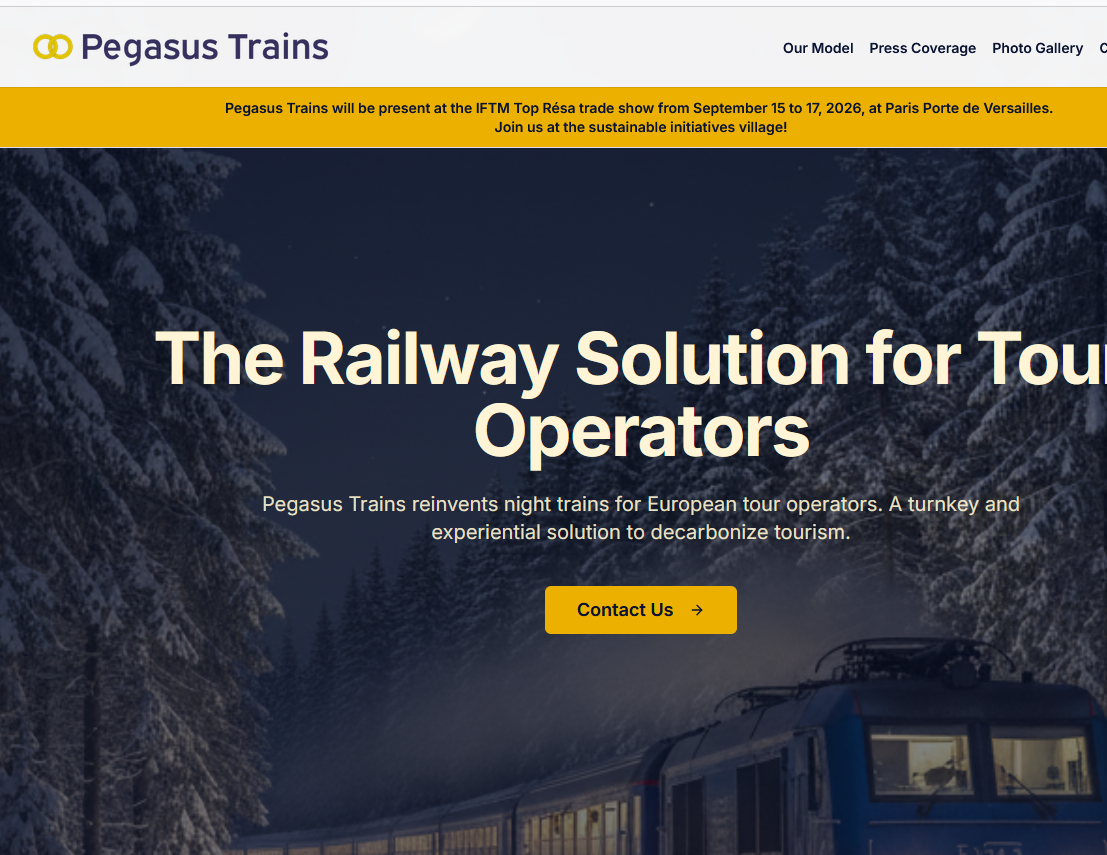
One of the newest entrants is Pegasus Trains, a French railway operator founded in 2024 that has deliberately taken a different approach. Instead of announcing ambitious cross-European networks or competing head-on with established operators, Pegasus quietly spent nearly two years building its operational capabilities before publicly unveiling its first successful season. Its first winter operation connected Paris with the French Alps on behalf of tourism company Compagnie des Alpes, transporting around 660 passengers per departure during the ski season. Following this initial success, Pegasus has already secured a contract extension and announced a second seasonal service from Amsterdam, Rotterdam, Antwerp and Brussels to the Alps.
A Different Market Entry Strategy
Unlike many previous rail startups, Pegasus is not positioning itself primarily as another consumer-facing railway brand.
Instead, the company describes itself as a bridge between two industries that traditionally have little operational overlap: railway operations and tourism. While rail operators know how to run trains safely and efficiently, they often lack direct access to tour operators and package holiday providers. Conversely, tourism companies understand customer demand but rarely possess the expertise required to operate trains.
Pegasus fills this gap by acting as the operational partner for travel companies that want dedicated rail services without becoming railway undertakings themselves.
This business-to-business model offers several advantages.
First, demand is substantially more predictable. Services are often contracted well before departure, reducing commercial risk.
Second, marketing costs are significantly lower because Pegasus sells capacity through established tourism partners rather than competing for every passenger against airlines, cars and incumbent railway operators.
Third, the company focuses on seasonal leisure markets where demand peaks are well understood, making fleet planning easier than operating year-round scheduled services.
Perhaps most importantly, Pegasus avoided one of the biggest mistakes made by many transport startups: promising future services before proving operational reliability. The company intentionally remained largely invisible until it had successfully completed an entire operating season.
The Challenges Ahead
Despite this promising beginning, Pegasus still faces significant challenges that affect nearly every independent railway operator in Europe.
Access to rolling stock
Obtaining suitable passenger coaches remains one of the industry's biggest bottlenecks. New rolling stock requires years to manufacture, while leasing markets remain tight due to increasing demand from new operators.
Infrastructure constraints
Even after market liberalization, obtaining attractive train paths is difficult. National infrastructure managers must balance freight, regional services, incumbent operators and new entrants, leaving limited capacity on popular corridors.
Cross-border complexity
International services require coordination across multiple infrastructure managers, safety authorities and operational rules. Every additional country increases operational complexity considerably.
Economics of seasonal services
Although seasonal trains reduce demand risk, they also create asset utilization challenges. Rolling stock that operates only during winter ski seasons must either find alternative work during the remainder of the year or generate sufficient returns within a relatively short operating window.
Lessons from Earlier Railway Startups
Pegasus is far from the first company attempting to reshape European passenger rail.
Several predecessors offer valuable lessons.
Locomore: Strong Brand, Weak Economics
German startup Locomore generated enormous public attention in 2016. Financed partly through crowdfunding, it positioned itself as a customer-friendly alternative to Deutsche Bahn with affordable fares, organic catering and environmentally conscious branding.
The enthusiasm, however, could not compensate for challenging economics. High fixed costs, limited operational flexibility and slower-than-expected passenger growth resulted in insolvency after only a few months. Although services later resumed under new ownership and partnerships, the original independent business model proved unsustainable.
HKX (Hamburg-Köln-Express)
HKX focused on one of Germany's busiest corridors between Hamburg and Cologne.
Rather than building a nationwide network immediately, HKX concentrated on a single route with clear demand. Nevertheless, competition from Deutsche Bahn, limited economies of scale and operational complexity made profitability difficult. Eventually HKX became integrated into what later evolved into today's FlixTrain network.
Eurostar: A Different Success Story
Eurostar demonstrates that new railway operators can succeed—but under very different conditions.
The operator benefited from unique infrastructure, international demand between major metropolitan areas, strong institutional backing and continuous long-term investment. Rather than competing on price alone, Eurostar built a premium product centered on convenience, city-center access and seamless international travel.
Today it carries more than twenty million passengers annually and continues expanding its European network while investing heavily in new rolling stock.
Why Pegasus May Have Better Odds
Pegasus appears to have learned from many of these historical examples.
Instead of trying to become the next national railway operator, it concentrates on a niche where rail has clear competitive advantages:
long-distance leisure travel,
high passenger volumes during predictable seasonal peaks,
partnerships instead of direct competition,
and business customers instead of expensive consumer acquisition.
This asset-light commercial strategy resembles successful models seen in aviation, where charter airlines operate flights on behalf of tour operators rather than relying entirely on direct ticket sales.
If executed well, this approach may prove more resilient than attempting to compete directly with incumbent rail operators on daily scheduled services.
Three Major Lessons from European Rail Liberalization
Looking across both successful and unsuccessful market entries, three common lessons emerge.
1. Solve a specific market problem, not simply offer another train
Successful entrants address an unmet customer need. Eurostar connected city centers across the English Channel. Pegasus simplifies dedicated rail travel for tourism companies. By contrast, operators that merely duplicate existing services often struggle to differentiate themselves.
2. Operational excellence matters more than marketing
Railways are capital-intensive businesses where reliability determines long-term success. Pegasus deliberately delayed public announcements until after completing its first successful season—a sharp contrast to several startups that generated publicity long before proving operational capability.
3. Partnerships reduce risk
Perhaps the biggest lesson is that collaboration often beats confrontation. Rather than fighting incumbents for every passenger, successful operators increasingly work alongside tourism providers, travel agencies, infrastructure managers and distribution platforms. Strategic partnerships create more stable demand while lowering customer acquisition costs.
Looking Ahead
The European rail market remains one of the most challenging transport sectors for new entrants. High capital requirements, regulatory complexity and operational risks have ended many ambitious ventures before they reached maturity.
Pegasus Trains is not guaranteed success. It will still face infrastructure bottlenecks, rolling stock shortages and the operational realities of cross-border passenger transport.
However, its cautious, partnership-driven market entry suggests a more mature understanding of what it takes to build a sustainable railway business. Rather than attempting to disrupt Europe's railways overnight, Pegasus is quietly building expertise, proving its operational capabilities and expanding step by step.
In an industry where many newcomers have promised too much too soon, that may ultimately become its greatest competitive advantage.